
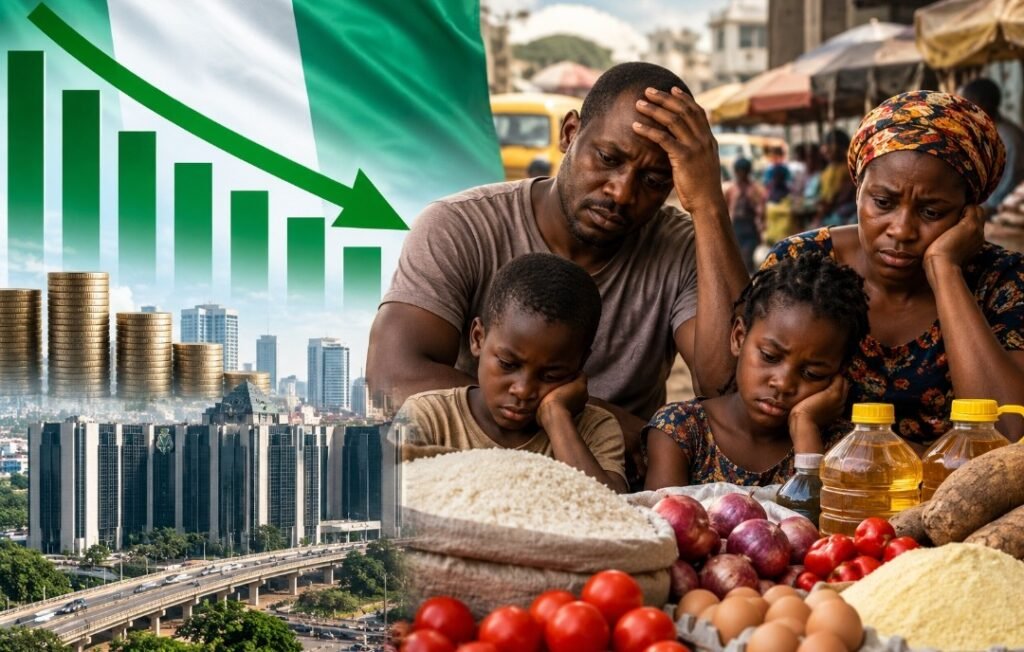
Nigeria’s latest economic figures provide evidence of continuing disinflation, but the experience of many households remains difficult.
The latest figures therefore raise a question that goes beyond whether inflation is falling.
Are Nigerians actually experiencing an improvement in their standard of living?
WHAT HAPPENED
Nigeria’s latest headline inflation figure stands at 15.43 percent.
Food inflation remains much higher at 20.31 percent.
The decline in headline inflation is an important development because it suggests that the pace at which prices are increasing has moderated.
But falling inflation does not mean that prices have returned to previous levels.
A slower increase in prices is very different from prices becoming cheap again.
WHY IT MATTERS
For a household already struggling with high food, transportation, electricity, housing and education costs, a reduction in the inflation rate does not automatically restore purchasing power.
This is why economic recovery must be measured beyond headline statistics.
The International Monetary Fund has acknowledged improvements in Nigeria’s macroeconomic position while also warning that conditions remain difficult for many Nigerians.
The World Bank has similarly reported that household incomes have not fully recovered and that poverty remains high.
THE HOUSEHOLD QUESTION
The real test of Nigeria’s economic reforms is whether ordinary citizens can eventually feel the improvement.
That means asking several practical questions.
Can families afford more food?
Are wages rising faster than living costs?
Are businesses expanding and creating jobs?
Can young Nigerians find productive employment?
Are transportation and energy costs becoming more manageable?
And are public revenues being converted into services and infrastructure that improve daily life?
THE POLITICAL SIGNIFICANCE
The economic debate will be central to the 2027 election.
The government can point to improved macroeconomic indicators, stronger revenue performance and greater economic stability.
Opposition politicians can point to the continuing hardship experienced by many households.
Both sides will increasingly attempt to define what economic success means.
For voters, the answer should not come from political slogans alone.
It should come from evidence and lived experience.
WHAT TO WATCH NEXT
The important indicators to watch are food prices, wages, employment, household purchasing power, business activity and poverty.
Nigeria also needs to ensure that improved government revenues translate into productive investment rather than simply larger government spending.
Nigeria may be moving towards greater macroeconomic stability.
But stability is not the same thing as prosperity.
The ultimate test of economic reform is whether Nigerians can afford more, earn more, produce more and live with greater security and dignity.
Until that happens, the debate over whether the economy is truly recovering will remain open.
We don’t just report the news. We analyse what it means.
By Viewers Corner News