
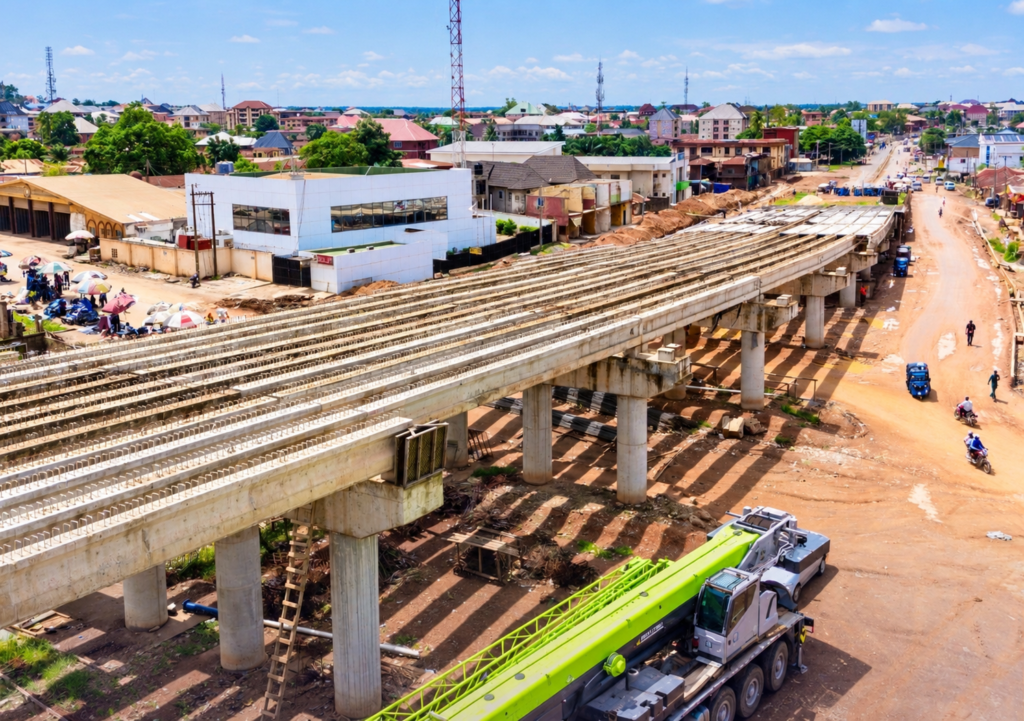
More than two years after the demolition of properties around Vanco Junction in Abakaliki, Ebonyi State, an important question remains:
What has happened to the Vanco flyover and underground tunnel project?
The project was presented as a major infrastructure development that would transform traffic movement around one of Abakaliki’s busiest areas.
But for residents, traders and property owners whose buildings and businesses were affected by the project, the story is much bigger than a flyover and tunnel.
It is a story about demolished properties, disrupted livelihoods, public money, compensation and repeated promises of completion.
THE DEMOLITIONS
The Vanco project required the demolition of shops, houses and other structures around the construction corridor.
For traders and property owners affected by the demolition, the consequences were immediate.
Businesses were disrupted.
Sources of income were lost.
Some residents were displaced.
And affected property owners began asking questions about compensation.
At the time, the Ebonyi State Government said compensation had been documented and that affected people would receive payment.
But reports from affected residents at the time indicated that some had not received compensation.
This created an issue that should never have been allowed to disappear from public discussion: Were all affected property owners actually compensated?
THE MONEY BEHIND THE PROJECT
This is where the Vanco story becomes a public accountability issue.
Records on Ebonyi State’s electronic procurement portal show that the contract for the construction of the overhead bridge and underpass at Vanco Junction was awarded for about ₦8.61 billion.
The contract was signed on July 25, 2024, with a stated duration of 365 days.
That means the contractual completion date was July 25, 2025.
The same procurement record shows the balance to be paid to the contractor as zero.
That raises an important question.
If the contract record shows the financial obligation as settled, what exactly was delivered by the contractual completion date?
THE COMPLETION QUESTION
The Vanco project did not meet the original one-year completion timeline.
By March 2025, the Ebonyi State Government was already responding to concerns about the slow pace of work and assuring the public that the flyover and tunnel would be completed.
By December 2025, concerns about stalled government projects in Ebonyi included the Vanco tunnel and flyover.
Then, in June 2026, the government again said the Vanco project was on course.
The Commissioner for Works said the major critical aspect of the project had been completed and that ancillary work would be completed by December 2026.
Another government-linked account in June 2026 put the project at about 70 percent completion and projected completion for January 2027.
This creates a very important timeline.
The original contract completion date was July 2025.
The project was not completed by that date.
The government continued to assure the public that the project would be completed.
And by 2026, a new completion target had emerged.
So Nigerians are entitled to ask:
Why did a project originally given 365 days require a new completion timeline?
WHERE IS THE MONEY GOING?
There is another question that deserves answers.
The Ebonyi State Government has described the Vanco project as a major infrastructure investment and, in 2026, put the broader flyover and tunnel project cost at about ₦28.45 billion.
Yet the state’s procurement records show an ₦8.61 billion contract for the overhead bridge and underpass.
These figures need to be properly explained.
Are they different components of the same wider project?
Were additional contracts or variations approved?
How much has actually been paid?
How much remains to be paid?
What work does each contract cover?
And what is the final expected cost to the people of Ebonyi State?
These are not unreasonable questions.
They are basic questions about public expenditure.
WHAT ABOUT THE PEOPLE WHO LOST THEIR PROPERTIES?
There is another side to this story that cannot be ignored.
The people whose properties were demolished did not experience the project as a budget figure.
They experienced it as the loss of shops, homes, businesses and income.
In 2024, affected traders and property owners complained publicly about the demolitions and alleged that they had not received compensation.
The government subsequently said compensation had been documented and would be paid.
The governor later said the state had spent more than ₦1.5 billion compensating property owners affected by the Vanco tunnel.
That claim deserves to be examined against the records.
Who received the compensation?
How many property owners were compensated?
How much did each person receive?
When were the payments made?
Were traders and tenants also compensated, or only property owners?
And can the government publish the compensation records so that affected citizens can verify them?
If the compensation has genuinely been paid to everyone affected, publishing the records would help settle the dispute.
If some people were left out, they deserve to know why.
THE CITIZENS ARE STILL LIVING WITH THE CONSEQUENCES
This is why the Vanco project cannot be judged only by the eventual completion of the flyover.
The government must also consider what happened to the people who sacrificed their properties and businesses for the project.
Development is supposed to improve people’s lives.
It should not leave citizens carrying the economic burden of a project indefinitely while waiting for the promised benefits.
A government has the right to acquire land and remove structures when necessary for legitimate public infrastructure, subject to the law and appropriate compensation.
But that authority comes with a responsibility.
If people’s properties are removed, compensation must be transparent.
If businesses are disrupted, the government must account for the impact.
If public money is committed, the project must be delivered.
And if there are delays, citizens deserve an explanation.
THE BIGGER EBONYI QUESTION
Vanco is therefore bigger than one flyover.
It raises questions about how Ebonyi State plans, finances and delivers major infrastructure.
It raises questions about contracts.
It raises questions about project timelines.
It raises questions about compensation.
And it raises questions about whether the public can easily follow the money from budget allocation to completed infrastructure.
The people of Ebonyi State should not have to rely on political arguments or social media posts to determine whether a major public project is progressing.
They should be able to see the contract.
They should be able to see the amount committed.
They should be able to see what has been paid.
They should be able to see the physical progress.
And they should be able to know the expected completion date.
WHAT SHOULD HAPPEN NOW?
The Ebonyi State Government should provide a clear public update on the Vanco project.
The update should show the original contract value, any additional contracts or variations, the total amount paid so far, the work completed, the outstanding work and the current completion date.
The government should also make the compensation records available for affected property owners to verify.
And if contractors have failed to meet their contractual obligations, citizens deserve to know what action has been taken.
The Vanco project was supposed to represent development.
But more than two years after the demolitions that cleared the way for the project, the people of Ebonyi deserve more than promises.
They deserve a completed project.
They deserve transparency.
They deserve accountability.
And the people whose homes, shops and businesses were affected deserve clear answers about their compensation.
The question is therefore not whether Ebonyi State should develop.
Of course it should.
The question is whether development can be delivered in a way that respects citizens, protects public money and keeps government accountable.
Vanco is now a test of all three.
Two years after the demolitions, Nigerians deserve to know:
What happened to the project?
Where did the money go?
What remains to be done?
And when will the people of Abakaliki finally receive the infrastructure they were promised?
We don’t just report the news.
We analyse what it means.
By Viewers Corner News