
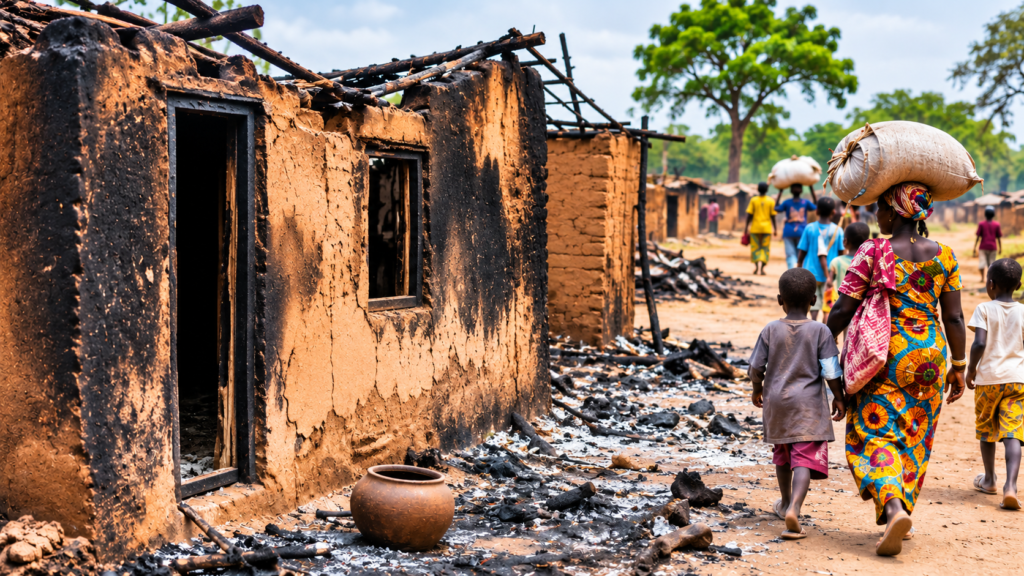
Sixty-two people reportedly killed. Fifty-two injured. Another 5,187 displaced.
These are the devastating figures from the National Emergency Management Agency’s preliminary assessment of the attack on Binnari community in Karim-Lamido Local Government Area of Taraba State.
Behind every figure is a family that has lost someone, a survivor recovering from injuries, or a household forced to abandon its home.
The attack occurred on 23 October. Gunmen reportedly descended on the community, leaving deaths, destruction and thousands of residents displaced.
But the question Nigeria must confront goes beyond the casualty figures: How did an attack of this scale happen, and where was the protection that residents should have received?
The government cannot respond with condolences, promises of relief and another announcement of security operations. Binnari needs answers backed by evidence.
WHERE WERE THE SECURITY WARNINGS?
Did intelligence agencies receive information about a possible attack before 23 October? Were warnings issued by residents or local authorities? If warnings existed, who received them, what action was taken and why did the attack still happen?
If no actionable intelligence was available, what gaps prevented security agencies from identifying the threat?
The government must provide a credible account. It cannot continue to treat every major attack as an isolated incident without examining whether earlier warnings, intelligence failures or weaknesses in community protection contributed to the tragedy.
HOW DID THE SECURITY RESPONSE UNFOLD?
When did authorities first receive distress calls? How long did security personnel take to respond? Which units were deployed, and what happened after they arrived?
Were there enough personnel and operational resources to protect the community? Were residents left exposed while help was delayed?
These are specific questions that require an official timeline, not vague assurances that security agencies are investigating.
VCN will not assign responsibility to a particular group without reliable evidence. But that does not remove the government’s obligation to establish who carried out the attack, investigate how they operated and explain whether any preventable security failures occurred.
5,187 PEOPLE DISPLACED. WHERE IS THE RELIEF PLAN?
The reported displacement figure represents a humanitarian emergency.
Thousands of residents need shelter, food, clean water, medical care, sanitation and protection. Families who have lost their homes and livelihoods cannot survive on government statements.
What immediate assistance has reached Binnari’s displaced residents? Which camps or host communities are accommodating them? How many people have received food, shelter and medical attention? Which agencies are responsible, and what resources have been released?
The federal and Taraba State governments must publish a coordinated relief plan with identifiable locations, beneficiary figures, responsible agencies and delivery timelines.
They must also establish how children, older people, injured residents and other vulnerable displaced persons are being protected.
Where public funds or relief materials are allocated, the government must account for their distribution. Emergency assistance must reach the people it is intended for, not disappear into administrative promises.
WHO WILL ACCOUNT FOR THE DAMAGE AND THE MISSING?
NEMA’s figures are preliminary. Authorities must reconcile the reported death toll, document missing residents, verify the number of injured people and establish the full extent of damage to homes, farms and businesses.
Families deserve reliable information about missing relatives. Survivors need access to medical treatment and continued support.
The government must also explain how displaced residents will return safely, what protection arrangements will be in place and whether damaged homes and livelihoods will receive assistance.
Returning people to an unsafe environment without addressing the security threat would simply expose them to further danger.
WHAT WILL CHANGE BEFORE ANOTHER COMMUNITY IS ATTACKED?
This is perhaps the most important question.
Will security deployments be strengthened in vulnerable communities? Will intelligence gathering and early-warning systems improve? Will local distress reports trigger faster responses? Will there be regular security assessments and independent reviews of response failures?
The government must identify the specific measures being introduced, the agencies responsible, the resources committed and the deadlines for implementation.
If an investigation identifies negligence or failures by public officials, appropriate disciplinary or legal action must follow. Public office and security responsibility must not become shields against accountability.
BINNARI NEEDS PROTECTION, NOT ANOTHER OFFICIAL STATEMENT.
Sixty-two reported deaths and 5,187 displaced residents cannot be treated as another statistic in Nigeria’s worsening insecurity.
The people of Binnari need to know why their community was vulnerable, whether warnings were ignored, how the security response unfolded and what is being done to prevent another attack.
The Presidency, the security leadership and the Taraba State Government must provide answers that can be independently examined.
Who was responsible for protecting Binnari? What failed? Who will answer for those failures? And what concrete guarantees can the government offer residents that they will not face another attack?
A government cannot measure its security performance by the number of operations it announces. It must also account for the communities it fails to protect and demonstrate what it does to prevent another tragedy.
Binnari deserves more than sympathy. Its people deserve protection, relief, justice and answers.
We don’t just report the news. We analyse what it means.
By Viewers Corner News