
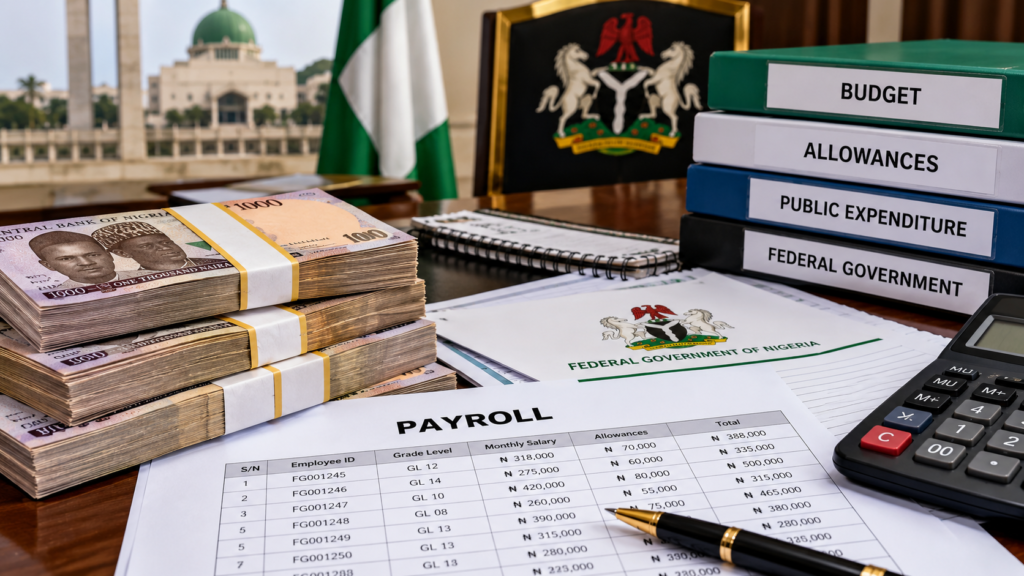
The Federal Government has approved a ₦70,000 monthly transport allowance for six months, beginning in November 2026. But before the first payment is made, Nigerians deserve answers about the programme’s total cost, funding source, beneficiaries and safeguards against payment failures.
The agreement followed a conciliation meeting between the Federal Government and the Nigeria Labour Congress (NLC) in Abuja on October 27.
The government presented the allowance as a response to rising living costs and workers’ demands for relief. It also promised to settle outstanding allowances and begin fresh minimum-wage negotiations.
Yet the announcement leaves important questions unanswered.
A temporary allowance involving potentially hundreds of billions of naira requires more than a public announcement. It requires a transparent financial plan and a clear system for tracking implementation.
Where Is the Full Cost of the Allowance?
PUNCH reported on October 29 that the six-month intervention could cost approximately ₦465.7 billion if all 1.1 million employee records on the federal payroll system qualify for the payment.
That figure is an estimate, not a confirmed government expenditure. The actual cost will depend on the number of eligible workers and the final payment arrangements.
But the estimate raises a basic accountability question: where is the government’s official cost breakdown?
How many workers are eligible? What total amount has been approved? Which budget line will finance the programme? Will the government publish monthly expenditure reports?
Nigerians should not have to rely on an estimate based on payroll records to understand the financial implications of a major public intervention.
The government should publish the projected number of beneficiaries, the total funding requirement and the authority under which the expenditure will be made.
Who Qualifies, and How Will Payments Be Verified?
The government’s announcement refers to a transport intervention for workers across levels. However, the exact number of beneficiaries and the detailed eligibility arrangements have not been clearly established in the available reporting.
Will the allowance cover every eligible federal civil servant, or will particular categories of workers be excluded?
How will the government handle employees on different salary structures, workers in federal agencies and staff whose payroll records require correction?
What mechanism will allow an eligible worker to report a missing or incorrect payment?
These are practical questions, not technical details that can be ignored until problems arise.
The government should publish the eligibility criteria and a timetable before payments begin. It should also explain how payroll records will be checked and how complaints will be resolved.
What Happened to the Previous Wage Award?
The Trade Union Congress (TUC) has rejected the new transport allowance, arguing that workers need a more permanent salary increase.
In its October 28 response, the TUC raised concerns about the implementation of the ₦40,000 wage award introduced in 2023. The union said some workers received incomplete payments, while others allegedly received little or none.
These are claims made by the union and should be answered with verifiable records.
The Federal Government should publish an account of the previous wage award: how much was budgeted, how many workers were eligible, how much was disbursed and how many outstanding cases remain unresolved.
If the government believes the previous programme was fully implemented, it should provide the evidence.
If some workers were left out, what corrective action was taken?
The public should not be asked to trust a new relief programme without clear answers about the implementation problems raised concerning its predecessor.
Why Is the TUC Rejecting the Allowance?
The TUC wants immediate salary increases and implementation of outstanding agreements affecting health workers under the Joint Health Sector Unions (JOHESU).
Its position differs from that of the NLC, whose leadership participated in the negotiations that produced the transport allowance agreement.
The government must therefore explain whether it considers the allowance a temporary intervention or a substitute for more permanent improvements in workers’ pay.
The distinction matters. A six-month payment has an end date. Workers’ living expenses do not.
The government and labour representatives also agreed to establish a Minimum Wage Negotiation Committee, but they did not settle the effective date for implementing a new minimum-wage arrangement.
When will the committee be constituted? When will negotiations begin in earnest? What timetable will guide the process?
An agreement to establish a committee is not the same as a new wage agreement.
What About the Outstanding Allowances?
The October 27 agreement also covered arrears of peculiar allowances dating from May 1, 2026, with payments scheduled in three equal instalments beginning in November.
For health workers, the government agreed to settle 19 months of outstanding allowance arrears within three months from December.
These are commitments that can be measured.
The government should publish the amounts owed, the number of affected workers, the payment schedule and the evidence that each instalment has been disbursed.
For health workers, it should also explain how it will meet the three-month deadline.
Will the Ministry of Labour publish monthly progress reports? Which agency will certify that the arrears have been paid? What happens if the deadlines are missed?
Without public reporting, Nigerians may know that a promise was made without knowing whether it was fulfilled.
Where Is the Wider Cost-of-Living Plan?
Transport support may help eligible workers meet commuting expenses. But it does not automatically reduce petrol prices, food costs, rent or medical bills.
What is the government’s plan for reducing the wider cost pressures facing workers and households?
What measures will address the concerns about petrol prices raised during the labour dispute? What has been done about tax relief? Which outstanding demands remain under consideration, and when will the government respond?
These questions matter because the effects of rising living costs extend beyond federal employees. State and local government workers, pensioners, private-sector employees and informal workers also face financial pressures.
The government should clearly distinguish between measures that support a specific group of employees and policies intended to ease the wider cost of living.
The Accountability Test Begins in November
The six-month transport allowance is scheduled to begin in November 2026. That gives the government an immediate opportunity to demonstrate transparency.
Before implementation, it should publish the final cost, funding source, eligibility criteria and payment schedule.
During implementation, it should report how many workers have been paid, how much has been disbursed and how complaints are being handled.
It should also provide a public timetable for settling outstanding allowances and progressing minimum-wage negotiations.
The TUC’s rejection must not be confused with proof that the programme has failed. Equally, the NLC’s participation in the agreement must not be treated as proof that all workers’ concerns have been resolved.
The evidence will emerge through actual payments, published records and compliance with agreed deadlines.
Nigerians should not have to wait until another labour dispute erupts to discover whether public commitments have been honoured.
The government has announced the allowance. Now it must publish the numbers, show the funding and prove that the money reaches eligible workers.
We don’t just report the news. We analyse what it means.
By Viewers Corner News