
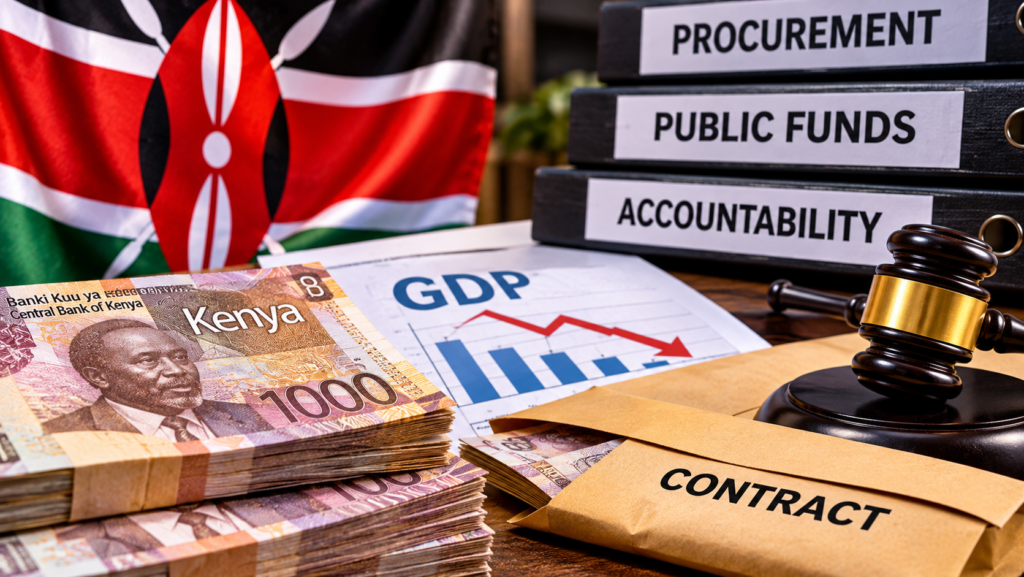
That is not merely a governance problem. It is a direct economic and public-finance burden.
The World Bank’s latest Kenya Economic Update warns that corruption is restricting economic growth, weakening public finances and preventing the benefits of development from reaching more citizens.
The lender says corruption and collusion increase fiscal deficits, create additional borrowing needs and raise the cost of government financing.
This means the consequences extend far beyond money lost through individual corrupt transactions.
When public contracts are manipulated, competition is weakened. When officials favour connected companies, taxpayers may receive poorer value. When public projects are overpriced or poorly delivered, government must find additional money to correct failures or complete unfinished work.
The result is more pressure on public finances and less money available for essential services.
The Kenyan Treasury says reforms are underway.
Treasury Principal Secretary Chris Kiptoo cited predictable payment timelines for contractors, a new conflict-of-interest law and digitisation of government procurement.
These measures may help, but announcing reforms is not the same as demonstrating results.
How many procurement processes are now fully open to public scrutiny? How many contracts were awarded through competitive bidding? How many single-bid contracts have been identified? How many contracts were varied after award, and why?
Who are the beneficial owners of companies receiving major public contracts? Have procurement officials or contractors been investigated for collusion? How many cases have resulted in sanctions, prosecution or recovery of public funds?
These are the records that will demonstrate whether the reforms are working.
Digitising procurement is useful, but moving an opaque process online does not automatically create transparency.
The public needs accessible information showing the original tender, winning bidder, contract amount, beneficial ownership, variations, payment records, implementation milestones and final delivery.
The World Bank also raised its 2026 growth forecast for Kenya from 4.3 per cent to 4.6 per cent following stronger-than-expected growth in the first half of the year.
That is positive, but the corruption warning cannot be ignored.
Economic growth does not automatically mean citizens are benefiting fairly. A country can expand its economy while public resources are diverted, borrowing costs increase and essential services remain underfunded.
The August 2027 general election also creates an important test.
As political competition intensifies, the government must demonstrate that procurement rules, public spending controls and conflict-of-interest requirements will be enforced consistently.
The Kenyan government should publish measurable anti-corruption targets, including investigations opened, cases concluded, public funds recovered, contracts reviewed and officials sanctioned.
The World Bank has identified the economic cost. The government must now demonstrate the political will to reduce it.
Corruption is not just about dishonest individuals enriching themselves.
It is about the schools not built, the hospitals not equipped, the roads not completed and the debt citizens must eventually repay.
Kenya deserves more than another promise to fight corruption.
It deserves evidence that public money is being protected.
We don’t just report the news. We analyse what it means.
By Viewers Corner News.