
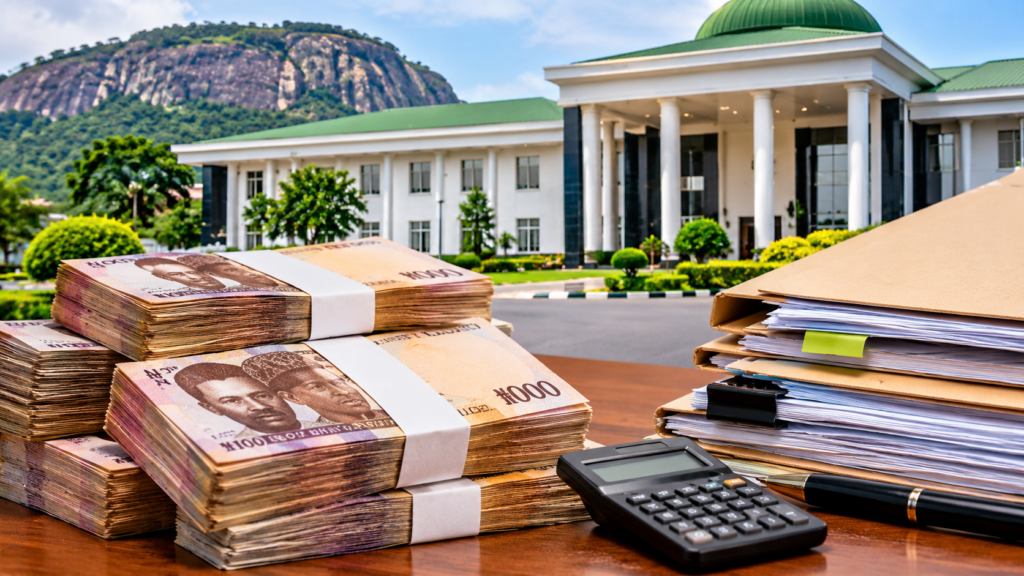
Ebonyi State recorded more than ₦17.58 billion in expenditure under a budget heading called “Donations to Official State Guests” between January and September 2026. That is approximately 97 per cent of the entire year’s allocation, spent before the final quarter had even begun.
Yet the public implementation report does not tell taxpayers who received the money, what they received it for or who authorised the payments.
This is not a minor accounting gap. It is a serious public accountability question that Governor Francis Nwifuru’s administration must answer.
According to Ebonyi State’s Third Quarter 2026 Budget Implementation Report, dated October 28, 2026, expenditure under economic code 22021022 reached ₦17,582,011,096.97 against an annual allocation of ₦18.133 billion.
The figures are extraordinary enough to demand a detailed explanation.
Almost the entire annual budget for this expenditure category was consumed within nine months. But the published expenditure table provides no transaction-level breakdown that would allow residents to establish who benefited from the payments and what public purpose they served.
Who received ₦17.58 billion of Ebonyi taxpayers’ money?
Was the money distributed to individuals, organisations, visiting government officials or institutions? Were these cash donations, gifts or other forms of assistance? Were the payments connected to official visits, ceremonies, government functions or other activities?
Who recommended the payments? Which officials approved them? What rules governed the decisions, and where are the supporting records?
The administration cannot expect residents to accept a broad budget description as sufficient accountability for expenditure of this magnitude.
Almost 97 per cent spent. What justified the payments?
The issue is not whether a government can ever provide legitimate assistance or make donations to official guests. There may be circumstances in which such expenditure is justified.
The issue is whether the scale, frequency, purpose and approval of these payments can be defended with verifiable records.
If ₦17.58 billion was spent within nine months, the government should be able to produce a detailed schedule showing every payment, its recipient, date, amount, purpose and approving authority.
The public should also know whether the expenditure followed established financial procedures and whether the payments delivered any identifiable public value.
Without that information, residents are left with a substantial expenditure figure but no meaningful explanation of how their money was used.
₦7 billion for vehicles. Where are the spending priorities?
The same budget implementation report records approximately ₦7 billion in motor vehicle purchases by September, against an annual allocation of ₦8.566 billion.
That represents approximately 81.7 per cent of the annual vehicle-purchase allocation.
Meanwhile, total capital expenditure stood at approximately ₦158.23 billion, representing only 22 per cent of the annual capital allocation of about ₦719.55 billion.
These figures raise questions that the state government cannot dismiss.
Why were almost all the funds allocated to donations for official state guests spent within nine months while capital expenditure remained at just 22 per cent of its annual allocation?
Which projects were delayed? Which capital allocations remained unspent? Were funds available for infrastructure and public services but not translated into completed projects?
The figures alone do not establish that one spending category caused another to suffer. But they do justify demanding an explanation of the administration’s spending priorities.
Residents need roads, functioning public facilities, improved healthcare, better schools and economic opportunities. They should be able to see how government expenditure translates into those outcomes.
A government cannot simply point to its total budget and claim development progress. It must demonstrate what the money actually delivered.
The Governor must explain how this spending serves his People’s Charter of Needs
Governor Francis Nwifuru presented the 2026 budget as the Budget of Actualisation and Hope, anchored on his administration’s People’s Charter of Needs philosophy.
That commitment should provide a clear standard against which public spending is assessed.
How does spending ₦17.58 billion on donations to official state guests advance the needs of ordinary Ebonyi residents?
What measurable public benefit did the payments deliver? How were the beneficiaries selected? Were the expenditures connected to specific government programmes or public objectives?
The administration should not expect its development promises to be judged only by speeches and budget presentations. Its actual spending decisions must also withstand public examination.
Where are the Ministry of Finance and the Assembly?
The Ministry of Finance and the Ministry of Budget, Planning and Development must publish a complete transaction-level schedule of the ₦17.58 billion expenditure.
That disclosure should include:
- Names of recipients or beneficiary organisations, subject to lawful privacy requirements.
- Dates and individual amounts of payments.
- The specific purpose and justification for each payment.
- The officials who initiated, recommended and approved the expenditure.
- Supporting vouchers, approvals and relevant financial documentation.
- The applicable financial rules and budgetary authority.
- Any outstanding commitments or payments not yet captured in the report.
The Ebonyi State House of Assembly must also explain what scrutiny it has applied to this expenditure.
Was the implementation report examined beyond the headline figures? Did legislators request the payment schedules? Have they questioned the relevant ministries about the near-total consumption of this allocation?
The Assembly’s responsibility does not end with receiving a budget implementation report. It must exercise meaningful oversight over how public funds are spent.
The Auditor-General should independently examine the expenditure, establish whether the payments were properly authorised and documented, and report any irregularities identified.
If the expenditure complied with the law, the records should demonstrate that. If irregularities are established, the responsible authorities must take appropriate action.
Public money requires public accountability
Let us be clear: a large expenditure is not automatically evidence of fraud. A budget implementation report alone cannot establish corruption, and no recipient or public official should be accused without evidence.
But the absence of proof of wrongdoing does not remove the government’s obligation to explain its spending.
The ₦17.58 billion is public money. Residents have a right to know how it was used, who benefited and what public purpose justified the payments.
Governor Nwifuru’s administration must answer these questions with records, not another general statement about development.
The questions are straightforward:
Who received the ₦17.58 billion?
Why was approximately 97 per cent of the annual allocation spent within nine months?
Who approved the payments, and where are the supporting documents?
Why was capital expenditure only 22 per cent of its annual allocation by September?
What has the Ebonyi State House of Assembly done to examine these figures?
And will the Auditor-General independently verify the expenditure and publish the findings?
Ebonyi residents should not have to accept an expenditure of this magnitude on the strength of a single accounting description.
A government that spends public money must be prepared to account for every naira.
The ₦17.58 billion question is not going away. The government owes Ebonyi residents a detailed explanation.
We don’t just report the news. We analyse what it means.
By Viewers Corner News