
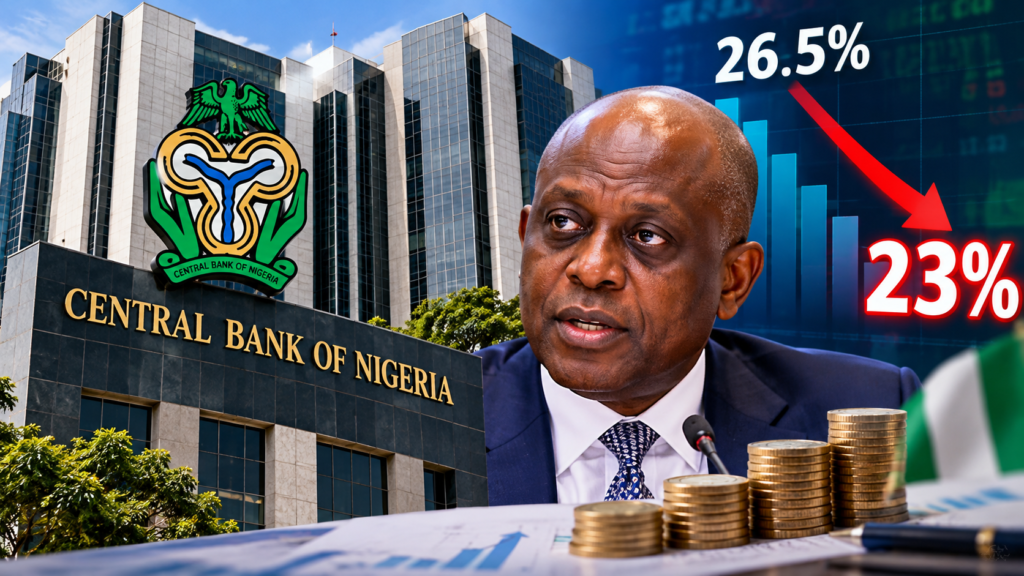
The Central Bank of Nigeria has reduced its Monetary Policy Rate from 26.5 percent to 23 percent, marking a significant change in the country’s monetary policy direction.
The decision was taken at the September 21–22 meeting of the Monetary Policy Committee, as the Central Bank responded to improving inflation and broader economic conditions.
The CBN also recalibrated its Standing Facilities Corridor around the new policy rate while retaining existing Cash Reserve Requirement levels for deposit money banks, merchant banks and non-Treasury Single Account public-sector deposits.
But what does the decision actually mean for ordinary Nigerians?
A lower Monetary Policy Rate does not automatically mean that commercial banks will immediately reduce the interest rates charged on loans. Banks still consider their own funding costs, risk assessments and other operating conditions when setting lending rates.
However, if the rate reduction eventually feeds through to commercial lending rates, businesses could find it easier and cheaper to access credit.
For small businesses, manufacturers and other companies that depend on bank financing, cheaper credit could make it easier to expand operations, invest in equipment, increase production and potentially create more jobs.
Consumers could also benefit if lower interest rates eventually make some forms of credit more affordable.
But there is another side to the decision.
If cheaper credit and increased spending push demand up faster than the economy’s ability to produce goods and services, inflationary pressures could return.
This means the CBN faces a delicate balancing act: supporting economic activity while protecting the progress made in bringing inflation under control.
For ordinary Nigerians, therefore, the announcement itself is only the beginning.
The real question is what happens next.
Will commercial banks reduce lending rates? Will businesses increase investment? Will access to credit improve? And, most importantly, will the policy change translate into better economic opportunities without triggering renewed inflation?
Those outcomes will determine whether the interest-rate cut becomes more than just a change in the CBN’s policy rate.
By Viewers Corner News