
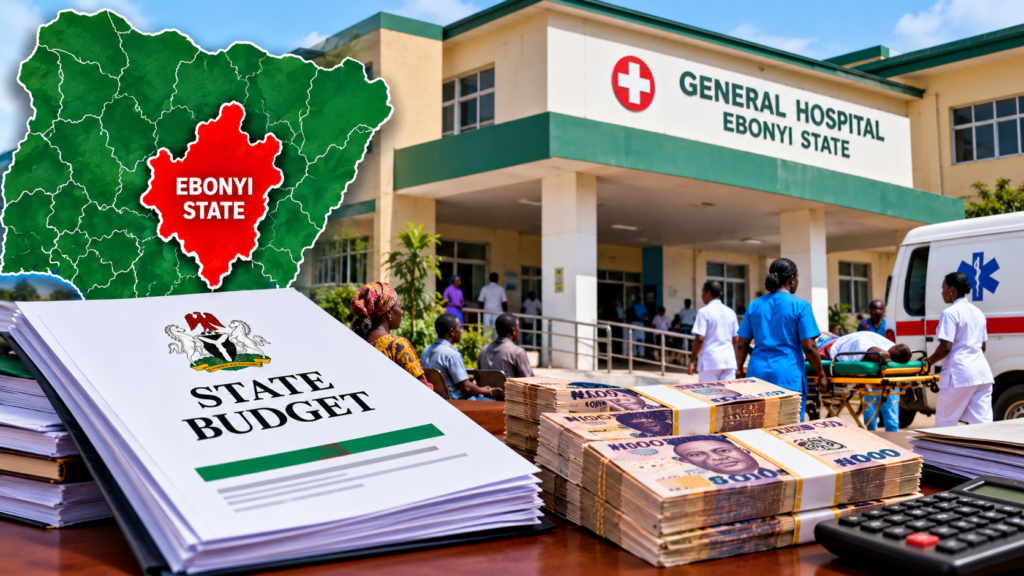
Ebonyi State’s 2026 budget implementation figures have raised questions about the pace at which public funds are reaching critical sectors, particularly health and education.
The state’s second-quarter budget implementation figures show that only ₦2.05 billion was released from a ₦33.37 billion capital allocation for the health sector between January and June 2026.
That represents about 6.2 percent of the health sector’s capital budget for the year.
Education also recorded relatively low capital releases during the same period. Of the ₦140.29 billion allocated for education capital projects, ₦14.99 billion was released during the first half of the year.
The figures become more significant when considered alongside the state’s reported total revenue of ₦210.64 billion during the six-month period.
Ebonyi reported that it spent ₦120.42 billion during the first half of the year, including ₦62.61 billion on capital expenditure and ₦57.81 billion on recurrent expenditure.
The figures do not, by themselves, establish financial wrongdoing.
But they raise a legitimate accountability question: why were capital allocations for essential sectors such as health and education released at such a slow rate during the first half of the year?
This distinction matters because an approved budget is not the same thing as actual expenditure.
A government may approve billions of naira for hospitals, equipment, schools and other infrastructure, but citizens ultimately benefit only when the money is released, projects are implemented and services improve.
The health sector deserves particular attention because delays in capital spending can affect the availability of medical equipment, rehabilitation of health facilities and other infrastructure required to improve healthcare delivery.
The issue therefore goes beyond Ebonyi State.
It is a national governance lesson.
Citizens need to be able to track the movement from budget approval to release, expenditure, project completion and measurable public benefit.
The next budget implementation report will be important.
Nigerians should watch how much of the remaining health and education allocations are released in the second half of the year, which projects receive funding and whether those projects can be independently verified on the ground.
By Viewers Corner News