
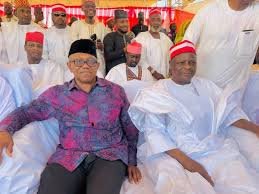
The political structure supporting Peter Obi and Rabiu Musa Kwankwaso ahead of Nigeria’s 2027 presidential election has entered an organisational dispute after the Nigeria Democratic Congress rejected a 59-member campaign council announced by the Obi-Kwankwaso Movement.
The Obi-Kwankwaso Movement recently announced a 59-member council comprising zonal and state coordinators and directors responsible for areas including mobilisation, women affairs, strategy, security, legal affairs, administration and other functions.
The structure includes representatives from Nigeria’s six geopolitical zones, the Federal Capital Territory and the 36 states.
However, the leadership of the Nigeria Democratic Congress subsequently said the council did not originate from the party and should not be regarded as an official party structure.
The Obi-Kwankwaso Movement has rejected that position.
The movement says it is an independent organisation and does not require the approval of an individual within the political party to establish its own organisational structures.
The disagreement creates an important organisational question for the emerging 2027 political arrangement.
Who has authority to speak for the presidential campaign?
What role should an independent support movement play?
And where should the responsibilities of a political party begin and end?
These questions matter because presidential campaigns require more than public enthusiasm.
They require clear chains of authority, coordinated communication, financial accountability, legal responsibility and defined decision-making structures.
Independent support movements can mobilise voters and expand a candidate’s reach.
Political parties, however, remain formal structures through which candidates contest elections and conduct regulated political activities.
The relationship between both structures therefore needs to be clear.
At this stage, the disagreement should not be presented as proof that the Peter Obi and Rabiu Musa Kwankwaso political arrangement is collapsing.
There is no established evidence of such a conclusion.
What is established is that the Nigeria Democratic Congress has rejected the campaign council as an official party structure, while the Obi-Kwankwaso Movement maintains that it has the independence to establish its own structure.
The dispute therefore raises a question of organisational authority rather than proving a wider political breakdown.
It also highlights one of the challenges facing political coalitions.
Different political figures and support groups can bring different constituencies, networks and organisational expectations into one political project.
That can broaden political mobilisation.
It can also create disagreements over who controls the campaign structure.
The way the current dispute is resolved could therefore provide an early indication of how the wider political arrangement intends to manage competing organisational interests.
What this reveals is that political coalitions require more than agreement around candidates.
They also require agreement about structures, authority and responsibility.
What to watch next is whether the Nigeria Democratic Congress formally establishes or recognises a campaign structure, whether the Obi-Kwankwaso Movement changes its position, and whether the disagreement affects the wider coordination of the 2027 campaign.
For now, the facts are straightforward.
A campaign council has been announced.
The political party has rejected it as an official party structure.
And the movement behind the council says it does not require that approval.
The next development will show whether the disagreement remains an organisational dispute or becomes a broader political issue.
By Viewers Corner News