
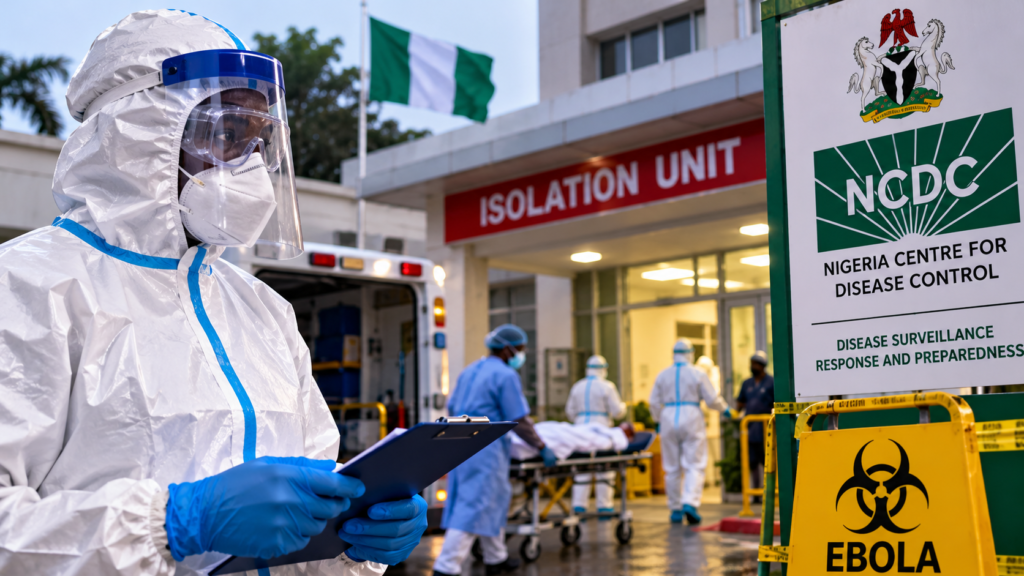
Two suspected Ebola cases in Nigeria’s North-East have reportedly tested negative after two rounds of testing. That is reassuring news. But it should not end the public-health questions raised by the country’s recent exposure to a confirmed imported case.
Nigeria’s health authorities have been monitoring a situation involving a Swiss woman who travelled from Uganda to Abuja before being evacuated, alongside her husband, to Switzerland. The woman was confirmed to have Ebola. Nigerian authorities identified 62 contacts for monitoring.
The two suspected cases in the North-East tested negative. The monitoring of identified contacts was expected to continue until November 13.
These developments underline an important point: Nigeria must be able to detect, investigate and contain a dangerous infectious disease before it spreads through communities.
There is no reason to create panic over negative test results. But neither should the public be asked to accept reassuring statements without knowing whether the country’s preparedness systems are functioning effectively.
The first question is how quickly the suspected cases were identified, isolated and tested. How long did it take health authorities to respond after receiving information about possible exposure? Were samples collected and transported promptly? Were the results communicated to the relevant health institutions without delay?
The second question concerns contact tracing.
Authorities identified 62 contacts in connection with the imported case. How many had completed the required monitoring? Were any contacts missed? Were all those who needed medical supervision reached? What arrangements were made to respond if anyone developed symptoms?
The public also needs clarity about the coordination between federal and state health authorities. Disease surveillance cannot depend on Abuja alone. Local health facilities, state epidemiology teams, laboratories, border health services and emergency response agencies must work together.
The North-East cases make this especially important. Nigeria’s ability to respond to a suspected outbreak depends on more than having a national emergency plan. It depends on whether frontline facilities can recognise warning signs, report cases, protect health workers, collect samples and arrange safe referral.
The Nigeria Centre for Disease Control and Prevention and the Federal Ministry of Health should provide regular, factual updates on the monitoring exercise without disclosing private medical information.
They should also explain whether isolation facilities, protective equipment, laboratory capacity, trained personnel and emergency response arrangements are adequate in the locations where suspected cases may be reported.
There is a wider lesson for Nigeria’s public-health system.
Outbreak preparedness is often discussed when a disease threatens the country. But the real test is whether the necessary systems are funded, maintained and ready before an emergency occurs.
What resources have been allocated to disease surveillance? Have funds reached the facilities responsible for detecting and reporting unusual infections? Are frontline health workers receiving regular training? Are laboratories equipped to handle suspected high-risk infections? Can authorities trace contacts across state boundaries when necessary?
These questions matter because an outbreak can expose weaknesses that have existed for years.
The government must also communicate responsibly. Public information should be timely and clear, distinguishing a suspected case from a confirmed infection and explaining what the test results mean. Confusing announcements can cause unnecessary fear, while delayed information can damage public trust.
Nigeria has reason to be relieved that the two suspected cases tested negative. But the country should use this experience to assess the entire chain of preparedness — from initial detection to laboratory confirmation, contact tracing and public communication.
The relevant authorities should publish a concise after-action account when the monitoring period is completed. It should explain what worked, what gaps were identified and what corrective measures will follow.
A negative test result is good news. It is not proof that the health system is fully prepared.
Nigeria must not wait for an outbreak to discover whether its surveillance system, laboratories and emergency response arrangements are strong enough to protect the public.
We don’t just report the news. We analyse what it means.
By Viewers Corner News