
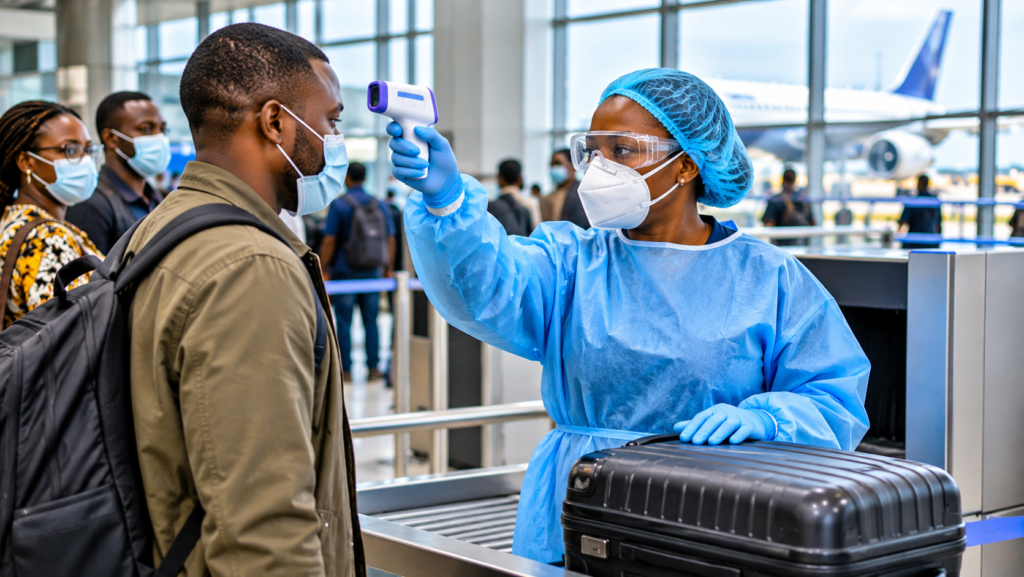
The Federal Government has approved a 20-year public-private partnership to establish a biosecurity and disease-surveillance system at five of Nigeria’s international airports.
The stated objective is to strengthen the detection of infectious diseases through surveillance equipment, sampling facilities, laboratories and a national operations centre.
It is an important public-health responsibility. But an important public-health objective does not give government officials a free pass on transparency, procurement or public spending.
The Federal Executive Council has approved the arrangement involving Bio Health Consortium and its partners. Yet Nigerians are being asked to accept a 20-year commitment without the full contract, financial structure and performance obligations being made publicly available.
That is not enough.
Reports have put the project’s value at $45.8 million, while other accounts have cited approximately ₦45.08 billion. These figures need to be reconciled. What exactly did the Federal Executive Council approve? What is the official contract value, in which currency, and what does the amount cover?
More importantly, who pays?
Will the private consortium finance the entire project and recover its investment through service charges? Will the Federal Government make direct payments? Are there government guarantees, minimum-revenue commitments, tax concessions or other financial obligations that could eventually fall on taxpayers?
These are not minor technical details. They determine the real cost of the agreement to Nigerians.
WHO GOT THE CONTRACT, AND HOW?
The government must explain how Bio Health Consortium and its partners were selected.
Was the contract competitively tendered? Which companies submitted bids? What technical and financial criteria were applied? Were independent assessments conducted? Who evaluated the proposals and recommended the winning consortium?
If the government believes this partnership offers better value than direct public procurement, it should publish the evidence supporting that decision.
Nigerians should not have to wait until problems emerge before discovering how a 20-year public contract was awarded.
WHAT EXACTLY WILL NIGERIA RECEIVE?
An announcement about laboratories, surveillance equipment and an operations centre does not establish that the project will deliver effective biosecurity.
Where will the facilities be located at Lagos, Abuja, Kano, Port Harcourt and Enugu airports? What equipment will be installed? Who will operate the laboratories? How many samples can they process daily? What standards will determine whether the system is functioning properly?
The contract should contain measurable performance targets, including testing turnaround times, detection accuracy, equipment availability, reporting procedures and response times when a public-health threat is identified.
Who independently verifies these results?
Without measurable targets and independent audits, how will Nigerians know whether the consortium is delivering what it was contracted to provide?
WHO OWNS THE DATA AND WHO PROTECTS IT?
Airport health surveillance involves sensitive personal and medical information.
Who will own the surveillance data? Who will have access to it? Where will it be stored? What cybersecurity safeguards will protect it against unauthorised access, misuse or breaches?
Will the private operator control critical health information for the next 20 years? What happens to the data, equipment and facilities when the agreement expires or is terminated?
These questions must be answered before the arrangement becomes operational, not after a data breach or contractual dispute.
WHAT HAPPENS IF THE CONSORTIUM FAILS?
A 20-year agreement must not become a long-term escape route for poor performance.
What penalties apply if laboratories are not completed on schedule, equipment repeatedly breaks down, testing targets are missed or surveillance services fail?
Can the government terminate the contract for persistent underperformance? What compensation would be payable if the agreement ends early? Who takes responsibility if a failure in the system delays the detection of a dangerous outbreak?
The public must not carry the financial consequences while a private operator retains the benefits of the arrangement.
THE GOVERNMENT MUST PUBLISH THE CONTRACT
The Federal Government should release the signed agreement, approved business case, procurement records, financing arrangements, payment obligations and performance framework.
It should also publish the annual reporting and independent audit requirements so that the National Assembly, civil society, public-health professionals and Nigerians can monitor implementation.
Strengthening airport biosecurity is a legitimate national priority. Nigeria needs the capacity to detect infectious threats early and respond before they become wider public-health emergencies.
But the urgency of public health must not become an excuse for secrecy in public contracting.
A 20-year partnership is not a routine government purchase. It is a long-term arrangement with implications for public finances, national health security, sensitive data and the accountability of future administrations.
The government must show Nigerians what they are committing to, what the private partner is expected to deliver, how much the country could ultimately pay and what protections exist if the arrangement fails.
Who scrutinised the contract before approval? Who verified the financial projections? Who will monitor the consortium for the next 20 years?
Until these documents and answers are made public, Nigerians are being asked to trust a long-term commitment they cannot properly examine.
A biosecurity project should protect the public, not shield a public contract from public scrutiny.
We don’t just report the news. We analyse what it means.
By Viewers Corner News