
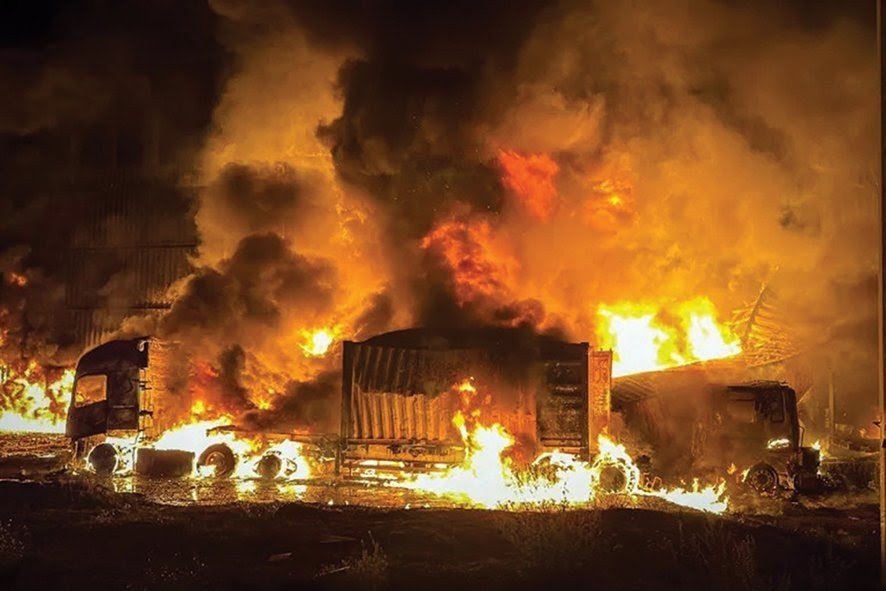
Russia’s latest large scale missile and drone attack on Ukraine reveals that the war is no longer only about territory or military targets. It is increasingly becoming a psychological war aimed at weakening Ukraine’s national identity, civilian morale, and long term ability to function as a stable society.
One of the strongest statements to emerge after the attacks came from Ukraine’s intelligence chief Kyrylo Budanov, who described the strikes as an assault on Ukrainian culture, memory, and identity. That statement is important because it reflects how Ukrainian leaders now view the conflict. They no longer see the war purely as a military invasion. They see it as an attempt to erase the idea of Ukraine as a distinct nation.
The destruction of a museum dedicated to the 1986 Chornobyl nuclear disaster carries deep symbolic meaning. Chornobyl remains one of the most painful historical events connected to the former Soviet Union. Striking a site connected to that memory sends a message far beyond military strategy. It touches history, trauma, and national consciousness.
Another major signal from the attack was Russia’s use of the Oreshnik missile, a weapon capable of carrying nuclear payloads and designed for long range strategic operations. Although Russia has used the missile only a few times since the war began, its deployment now appears intended to send a warning not only to Ukraine but also to NATO and Western allies supporting Kyiv.
Military analysts are likely to view the use of such advanced missiles as part of Russia’s broader strategy of pressure and intimidation. Moscow may be trying to demonstrate that it still possesses escalation dominance despite years of war, sanctions, and international isolation.
At the same time, Ukraine continues to project resilience. One striking image from the aftermath of the attack involved a newly opened cafe whose workers continued serving customers despite shattered windows and surrounding destruction. That scene represents something larger than business activity. It symbolizes civilian defiance and the determination of ordinary Ukrainians to maintain normal life despite constant bombardment.
The attacks on water supply infrastructure are also significant. Modern wars are increasingly targeting systems that sustain civilian life such as electricity, water, transportation, and communications. Damaging these systems before summer places additional pressure on both civilians and the Ukrainian government.
Another reality becoming clearer is that this war may continue far longer than many expected. Both Russia and Ukraine now appear deeply committed to endurance rather than quick victory. Russia believes it can gradually exhaust Ukraine and weaken Western support over time, while Ukraine believes continued resistance will eventually make the war too costly for Moscow to sustain politically and economically.
The humanitarian consequences continue to grow. Thousands of civilians have died since the war began, entire communities have been displaced, and repeated attacks on cities are creating psychological trauma that could affect generations.
At this point, the conflict increasingly resembles a war of exhaustion where military strikes are designed not only to destroy infrastructure but also to test national willpower. The longer the war continues, the greater the risk that instability, economic pressure, and global political divisions will deepen far beyond Eastern Europe.
By Viewers Corner News