
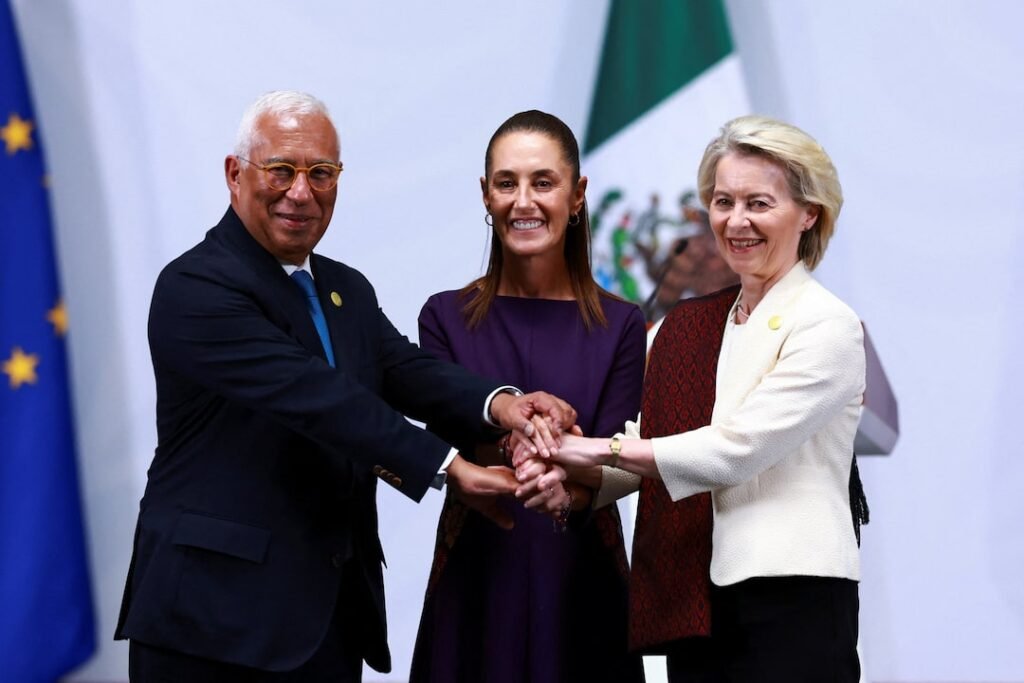
The newly finalized trade agreement between the European Union and Mexico is about far more than exports, tariffs, or commercial partnerships. It reflects a growing global movement among nations seeking to reduce dependence on the United States and protect themselves from rising geopolitical uncertainty.
For years, many countries built their economic systems around strong trade access to the American market. However, the return of aggressive tariff policies under President Donald Trump has forced several governments to rethink their long term economic strategies.
That is why the agreement between the European Union and Mexico carries major geopolitical significance.
Both sides appear to be preparing for a future where global trade may become more fragmented, politically sensitive, and influenced by strategic rivalries rather than pure economic cooperation.
For the European Union, the deal is part of a broader effort to diversify economic partnerships and avoid excessive dependence on either the United States or China. Europe increasingly understands that relying too heavily on a few major powers creates economic vulnerability during periods of political tension or trade disputes.
Mexico’s position is even more delicate.
The Mexican economy remains deeply connected to the United States because of geography, manufacturing supply chains, and decades of economic integration. At the same time, Mexico also understands the risks of depending too heavily on a single partner whose policies can rapidly change after elections or political shifts in Washington.
President Claudia Sheinbaum therefore appears to be balancing diplomacy carefully by strengthening ties with Europe while avoiding direct confrontation with the United States.
Another important issue behind the agreement is the growing use of economics as a geopolitical weapon. Tariffs, sanctions, export controls, and supply chain restrictions are now being used globally not just for economic protection but also for political influence and strategic pressure.
This means countries are increasingly searching for alternative markets, backup alliances, and new trade routes that can protect them during international crises.
The agreement also reflects a larger global trend where middle powers and regional blocs are trying to create more independent economic systems instead of remaining tied completely to superpower competition between Washington and Beijing.
In many ways, the world economy is quietly entering a new phase where globalization still exists, but trust between major powers is weakening.
Another interesting observation is timing. The agreement comes at a moment when international confidence in stable global trade structures has been shaken by wars, sanctions, shipping disruptions, energy crises, and political polarization.
For investors and governments, economic diversification is no longer simply good business strategy. It is becoming a national security strategy.
Ultimately, the European Union and Mexico may not just be signing a trade agreement. They may be preparing themselves for a future global economy where flexibility, strategic independence, and diversified alliances determine which nations remain economically stable during geopolitical uncertainty.
By Viewers Corner News